

I’ve been building on OTVP hardware since the platform launched, and I still remember how lost I felt staring at that first compiler error.
You’re here because you want to tap into the performance OTVP Computers deliver. But the architecture is different from what you’re used to. Different enough that your usual coding habits won’t cut it.
Here’s the reality: OTVP systems can outperform traditional setups by a wide margin. But you need to understand how they work first.
This otvpcomputers coding guide by onthisveryspot walks you through everything from setting up your development environment to running your first working application. No assumptions about what you already know. No skipping the basics.
I’ve taught dozens of developers how to work with OTVP architecture. The ones who succeed are the ones who start with the fundamentals and build from there.
You’ll learn how to configure your tools, write code that actually compiles, and run programs that take advantage of what makes OTVP different.
This isn’t theory. It’s the exact process I use and the same steps I walk new developers through when they join OTVP projects.
By the end, you’ll have a working application and understand why OTVP does things the way it does.
The OTVP Difference: Understanding the Core Architecture
I remember the first time I opened up an OTVP machine.
I expected something familiar. Maybe a beefed-up CPU with more cores. Standard stuff.
What I found was completely different.
Beyond Traditional CPUs
OTVP hardware doesn’t work like your laptop. It uses what’s called an Asymmetric Core design. That means you get high-speed logical processors working alongside specialized data-flow cores.
Think of it this way. Your regular CPU handles tasks one after another (or maybe a few at once if you’re lucky). OTVP splits the work. Some cores handle logic. Others manage pure data streams.
Why It Matters for Coders
Here’s where it gets real.
Your old code? The stuff you wrote for traditional processors? It’ll run on OTVP. But it won’t fly.
I learned this the hard way. I ported over a data analysis script I’d been using for years. It ran slower than on my desktop. Slower.
That’s because sequential code can’t tap into what makes OTVP special. You need to think in parallel data streams. You need to let those specialized cores do what they’re built for.
The otvpcomputers coding guide by onthisveryspot walks through this shift. It’s not just about learning new syntax. It’s about rewiring how you approach problems.
The Performance Payoff
Once you get it? The speed is unreal.
I’ve seen data analysis tasks that took hours finish in minutes. Simulations that would’ve run overnight complete before lunch.
But only if you write for the architecture.
Setting Up Your OTVP Development Environment
You’ve got two main paths here.
You can piece together your OTVP setup manually, grabbing individual components and hoping they play nice together. Or you can use the Software Development Kit that bundles everything you need in one package.
I’m going with the SDK every time.
The OTVP SDK gives you the compiler, libraries, and debugging tools right out of the box. No hunting down dependencies or fixing version conflicts at 2 AM (been there, not fun).
Here’s how to get it running.
First, head to the official OTVP developer portal and download the latest SDK. You’ll see different installation options when you run the installer. Pick ‘Full Installation’ so you get all the libraries. Trust me on this one.
Now here’s the part most guides skip.
You need to add the SDK’s ‘bin’ directory to your system’s PATH environment variable. Otherwise, you’ll be typing out full file paths every single time you want to run a command. That gets old fast.
If you’re using VS Code, grab the official ‘OTVP IntelliSense’ extension. It handles syntax highlighting and code completion, which saves you from memorizing every function name. Other IDEs work fine too, but VS Code has the best support right now according to the otvpcomputers coding guide by onthisveryspot.
Want to make sure everything installed correctly?
Open your terminal and run otvp-cli --version. You should see the version number pop up. If you get an error instead, the PATH variable probably didn’t get set right.
That’s it. You’re ready to start building.
Your First Program: ‘Hello, OTVP!’
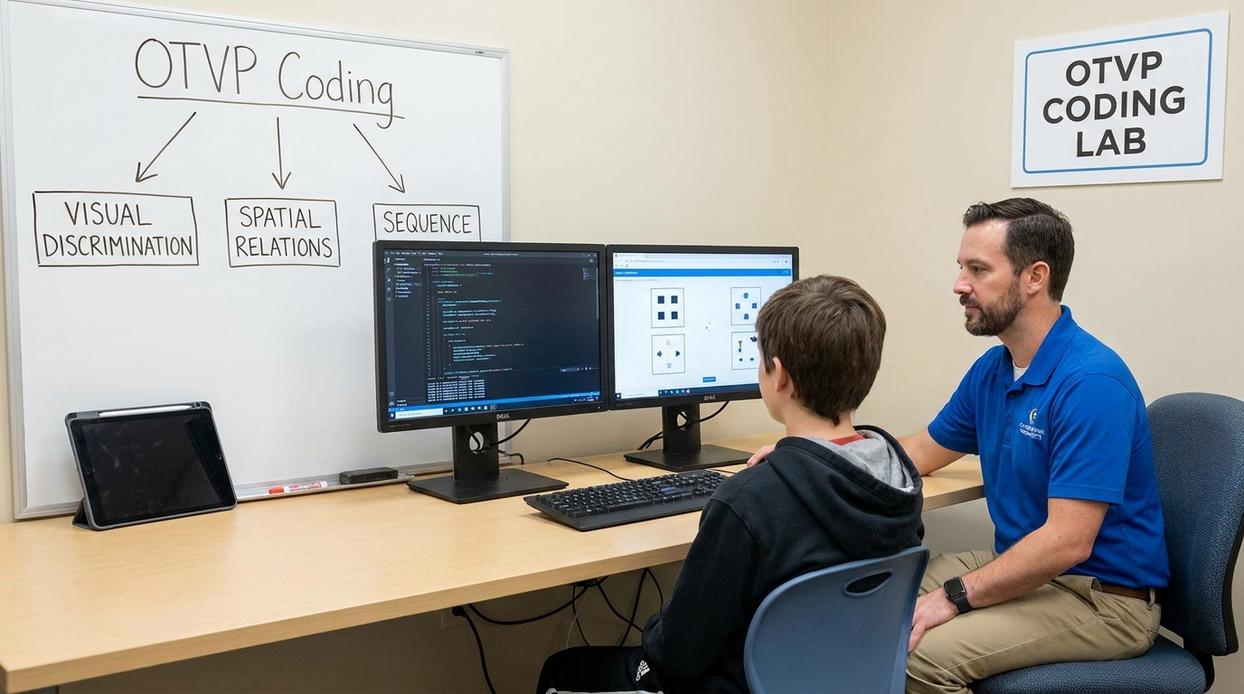
Let’s write some code.
I’m not going to bore you with theory about why FlowScript is amazing or how it’ll change your life. You want to see it work.
Meet FlowScript
FlowScript is the main language for OTVP. Think Python but with actual types (because we’re not savages) and special functions that talk directly to those Asymmetric Cores.
You’ll pick it up fast if you’ve written Python before. And if you haven’t? Don’t worry. It’s pretty straightforward.
Here’s your first program:
import otvp.core as core

def main():
    core.stream_print('Hello, OTVP!')
That’s it. Three lines and you’re officially an OTVP programmer. (Okay fine, maybe you need to actually RUN it first.)
Breaking It Down
Let me walk you through what’s happening here.
Line 1: import otvp.core as core
This pulls in the main OTVP library. Everything you need to talk to the hardware lives in here. The as core part just saves you from typing otvp.core every single time.
Line 2: def main():
Standard function definition. Nothing fancy. If you’ve seen any modern programming language, you know what this does.
Line 3: core.stream_print('Hello, OTVP!')
Here’s where it gets interesting. You could use regular print() but that’s slow. The stream_print() function is built for speed. It pushes output through OTVP’s high-throughput I/O system instead of crawling through standard output like it’s 1995.
This is what I mean by improved codes otvpcomputers. Functions that actually USE the hardware you paid for.
Running This Thing
Save your code as main.fs (that’s the FlowScript extension).
Now compile it:
flowc build main.fs
The compiler spits out main.out. That’s your binary.
Run it with:
otvp-run main.out
You should see “Hello, OTVP!” appear on your screen.
If you don’t? Check your syntax. FlowScript will yell at you about type errors before it even compiles. (Which honestly saves you headaches later.)
That’s your first program. Not bad for 250 words and three lines of code.
Core Concepts: Writing Efficient OTVP Code
Most developers I talk to struggle with OTVP at first.
They try to write code the same way they always have. One instruction after another, nice and linear.
That’s where things fall apart.
Thinking in Parallel: The Stream Paradigm
Here’s what you need to understand.
OTVP doesn’t work like your laptop. Think of traditional coding like a single checkout line at a grocery store. One person gets served, then the next, then the next.
OTVP is more like a river splitting into dozens of smaller streams. Each stream carries data to different processing cores at the same time.
You’re not writing instructions anymore. You’re directing traffic.
Some people argue this makes code harder to debug. They say parallel processing introduces too many variables and you lose control. Fair point. When ten things happen at once, tracking down bugs gets messy.
But here’s what that view misses. Sequential code on OTVP hardware is like buying a sports car and never leaving first gear.
Managing Data Streams
The otvpcomputers coding guide by onthisveryspot breaks this down pretty well.
You’ll use core.create_stream() to set up your data pathways. Then core.dispatch_task() sends work to available cores.
Here’s a basic example:
stream = core.create_stream(data_input)
core.dispatch_task(stream, process_function)
That’s it. You just sent a task to run on whatever core is free.
Memory Management Best Practices
The unified memory model sounds great until cores start fighting over the same data.
I’ve seen developers tank their performance by 60% because logical cores and data cores kept accessing the same memory blocks (it’s like two people trying to use the same wrench at the same time).
Keep your memory access patterns clean. Let data cores own their chunks. Don’t let your logical core constantly reach into data core territory.
Your Journey with OTVP Has Begun
You now have the essential skills to set up your environment, write code, and compile it for the OTVP platform.
I know the architecture looks complex at first. But the initial barrier to entry is manageable when you have the right guidance.
You’ve already proven you can do this. By following these steps, you’ve shown you can harness the power of OTVP Computers.
Here’s what you should do next: Dive into the otvpcomputers coding guide by onthisveryspot for more advanced techniques. Start experimenting with the parallel processing functions. That’s where you’ll see the true speed of this hardware.
The platform has more to offer than what we covered here. Your next move is to push the boundaries and see what you can build.
 Uryxara Holt is the kind of technology writer who pays close attention to how industries evolve around people rather than apart from them. As the founder of OTVP Computers, they approaches Latest Tech Innovations, Tech Industry Developments, and Hands-On Tech Tips with a broader perspective than simple trend coverage. Uryxara seems deeply interested in the relationship between technology and everyday adaptation — how digital tools slowly reshape routines, expectations, businesses, and even the way people think about problem-solving itself.